
AI & Emerging Technology
Shadow AI in the Workplace: The ChatGPT Prompt That Could Leak Your Company's Secrets
Highlights how using unauthorized AI tools can expose sensitive company data and create security and compliance risks.
The Prompt That Started It All
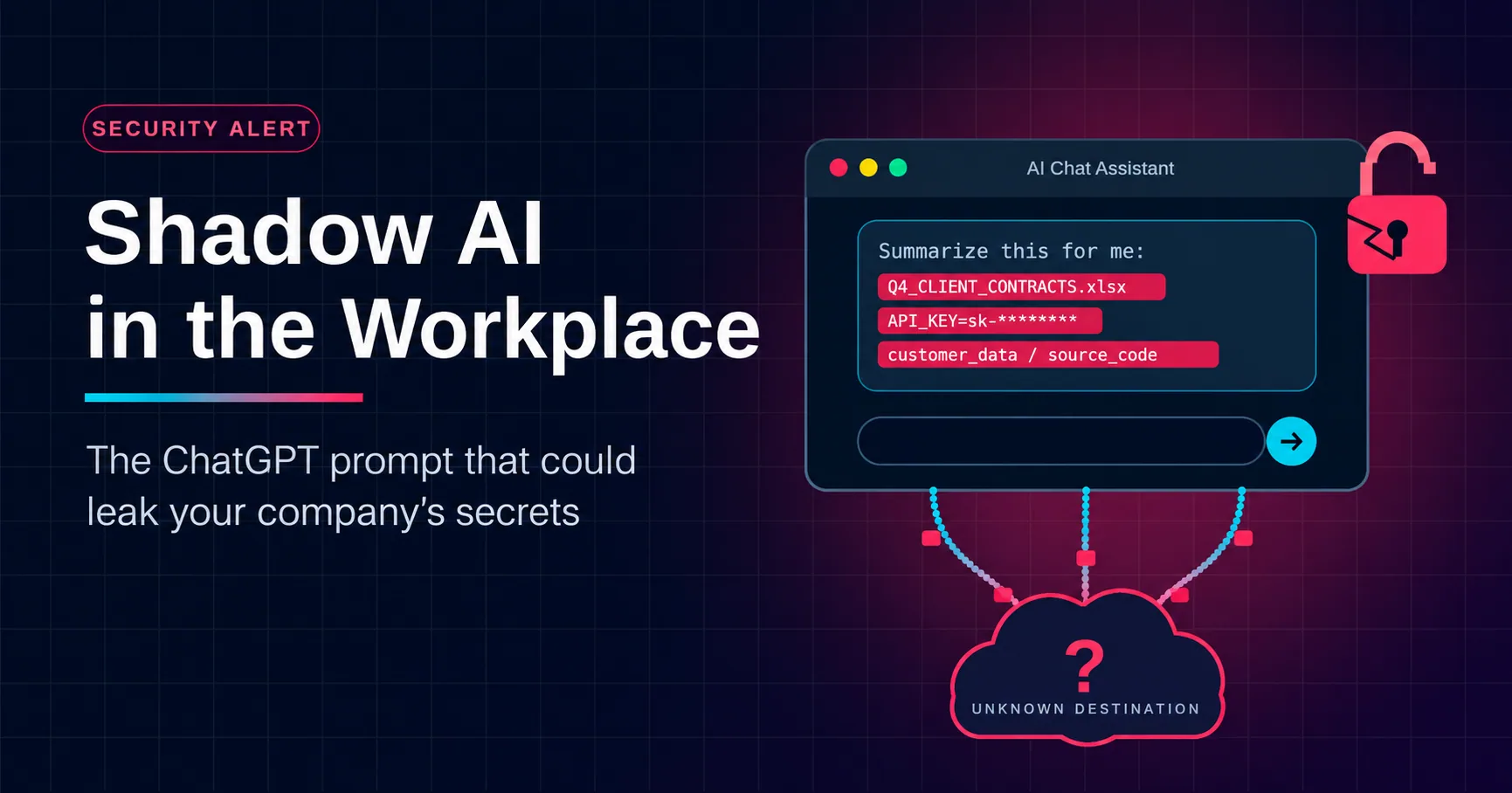
It was a routine Tuesday for a software engineer at a major electronics manufacturer. Stuck on a bug, he did what millions of developers now do without thinking twice he pasted a chunk of proprietary source code into ChatGPT and asked it to find the error.
It worked. The bug got fixed. He moved on with his day.
What he didn't realize was that he had just handed confidential, internal source code to a third-party AI system outside the company's control one that, at the time, could retain submitted data to help train future models. Within weeks, it happened two more times at the same company, once with a recording of an internal meeting, and once with equipment test data. By the time security teams caught on, it was too late to undo. The company's own confidential files had already left the building without a single firewall being breached, without a single password being stolen, and without anyone technically “hacking” anything at all.
This is Shadow AI. And it is already inside your organization, whether you've approved it or not.
What Exactly Is “Shadow AI”?
Shadow AI is the AI version of Shadow IT the long-standing problem of employees quietly using unauthorized apps and tools to get their jobs done faster. Except this time, the tool isn't a random file-sharing app or an unapproved messaging client. It's ChatGPT, Gemini, Copilot, DeepSeek, or one of hundreds of AI browser extensions tools employees now treat as essential as email.
The pattern looks the same across almost every industry:
A finance analyst pastes a client's financial model into an AI tool to “clean it up.”
An HR manager uploads a spreadsheet of employee salaries to generate a summary report.
A marketing executive drops an unreleased product roadmap into an AI assistant to draft a press release.
A developer feeds proprietary source code into an AI coding assistant to debug it faster.
None of these employees think they're doing anything wrong. They're not trying to leak data they're trying to hit a deadline. But every one of these actions sends sensitive company data to a system IT never approved, never audited, and in many cases, cannot even see.
Why This Is Spreading So Fast
Three forces are driving Shadow AI's rapid growth inside businesses of every size:
Speed beats policy. AI tools save employees hours of work. When a company's official, approved tools lag behind what's publicly available for free, employees route around the policy not out of malice, but convenience.
No visible red flag. Pasting text into a chat window doesn't look like a security event. There's no download, no attachment, no obvious trigger for a DLP (Data Loss Prevention) alert the way an email attachment might cause.
Low awareness of where the data goes. Most employees don't know or don't think about whether a given AI tool stores, trains on, or shares the data they submit. The interface feels private. The backend often isn't.
The Real Risk Isn't the AI It's the Lack of Visibility
Security teams have spent years building controls around known categories of risk: email, endpoints, cloud storage, removable media. Shadow AI slips past almost all of them because it doesn't look like a traditional exfiltration channel it looks like productivity.
The consequences, however, are very real:
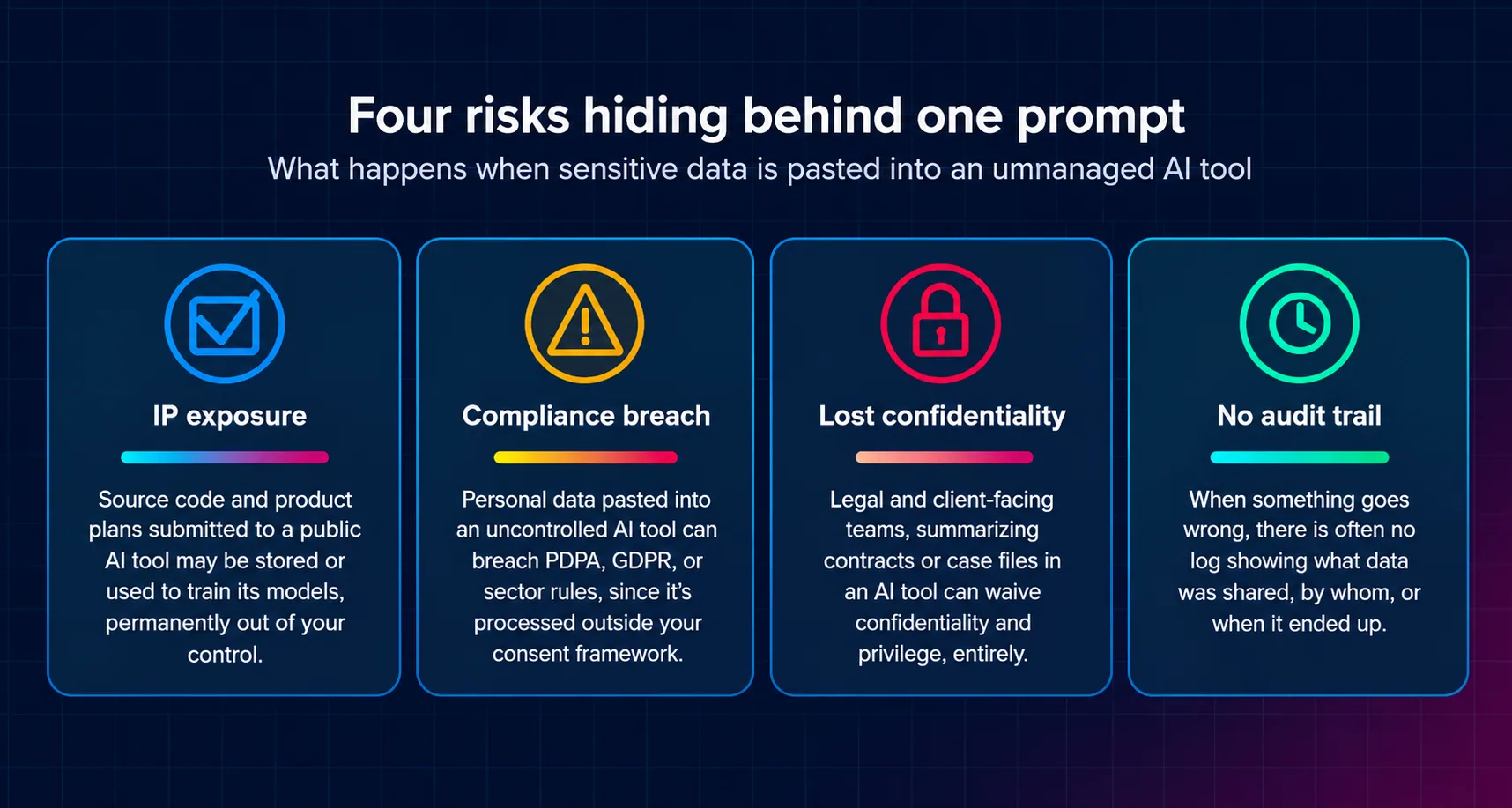
Intellectual property exposure - source code, product designs, and strategic plans submitted to external AI tools may be stored, logged, or in some cases used to improve the provider's models, permanently outside your control.
Regulatory and compliance violations - for organizations in Sri Lanka and the region, pasting personal data into an uncontrolled AI tool can directly breach obligations under the Personal Data Protection Act (PDPA), GDPR, or sector-specific regulations, since the data is often processed and stored outside the jurisdiction and consent framework the organization is accountable for.
Loss of attorney-client or contractual confidentiality - legal teams using AI tools to summarize contracts or case files risk waiving confidentiality protections entirely.
No audit trail - when something goes wrong, there's frequently no log showing what was shared, by whom, or where it went.
Why Simply Banning AI Tools Doesn't Work
The instinctive response for many organizations is to block AI tools outright at the network level. In practice, this rarely succeeds and often backfires. Employees move to personal devices or personal accounts, outside the network entirely, where there's even less visibility than before. The business loses the productivity benefits of AI while keeping all of the risk, just pushed further out of sight.
The goal isn't to eliminate AI from the workplace it's to bring it out of the shadows.
Bringing Shadow AI Into the Light
A practical, risk-based approach gives organizations the benefits of AI tools without surrendering control over sensitive data:
Discover before you restrict. Use network and SaaS monitoring to identify which AI tools are already in use across the organization. You cannot govern what you cannot see.
Publish a clear, practical AI usage policy. Define what categories of data (source code, customer PII, financials, legal documents) can never be submitted to public AI tools and communicate it in plain language, not legal jargon.
Offer sanctioned alternatives. Provide an approved, enterprise-grade AI tool with contractual data protections, so employees aren't forced to choose between productivity and policy.
Train for the “paste reflex.” Most Shadow AI incidents happen in seconds, without malicious intent. Awareness training should specifically address the habit of pasting data into AI chat windows the same way phishing training addresses the habit of clicking links.
Extend DLP and CASB visibility to AI platforms. Modern Data Loss Prevention and Cloud Access Security Broker tools increasingly support detection of sensitive data being submitted to generative AI endpoints use them.
Review vendor data-handling terms before approving any AI tool. Know exactly how long data is retained, whether it's used for model training, and where it's physically stored.
The Takeaway
Shadow AI isn't a future risk it's a present one, quietly running in the background of nearly every organization, one prompt at a time. The employees using it aren't the enemy; they're responding rationally to tools that make their jobs easier. The real failure isn't that AI exists in the workplace it's when organizations don't know it's there, haven't decided what's allowed, and have no way of seeing what's already left the building.
“The businesses that get ahead of this won't be the ones that ban AI. They'll be the ones that govern it.”
Related articles
All insights
AI in Defense: Fighting Hackers with Hackers
It was just past midnight when the security dashboard blinked to life. Thousands of login attempts poured in from unusual locations, files were being accessed at speeds no human…

When AI Becomes the Hacker
When AI Becomes the Hacker: The First Autonomous Cyber Espionage Campaign The cybersecurity landscape reached a historic inflection point in late 2025. For the first time, a…

The Rise of Defensive Deception
How Today’s Cyber Defenders Are Setting Smart Traps Latest Updates (May–June 2025) Google’s AI Safety Charter in India (June 2025): Designed to combat the growing wave of…